
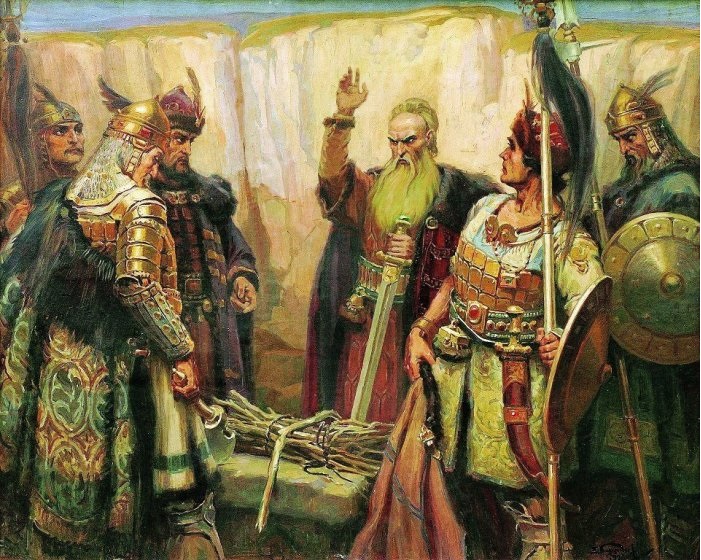
The origin of the modern Bulgarians is associated with Turkic people who in the past inhabited the Caucasus region. From there they gradually migrated westward and southward toward the Balkan Peninsula.
Origins
Sources concerning the Proto-Bulgarians are relatively scarce, and the study of their history relies heavily on early Byzantine authors. Of particular importance is the work of the Byzantine writer and historian Theophanes the Confessor. His Chronographia recorded valuable information about early Proto-Bulgarian history. He mentions the Proto-Bulgarian khan Kubrat, whose state extended over the territory of the Caucasus. Kubrat’s state was exposed to significant pressure from neighboring tribes. Before his death, the khan urged his sons to remain united in order to preserve the integrity of the people. His five sons took over the state, after his death.
The eldest son, Batbayan (or Bayan), remained in the ancestral homeland and continued to rule there, honoring his father’s request. Another son, Kotrag, also remained and went on to establish a Bulgar state in the Volga region. The third son, Asparuh, crossed the Dnieper and Dniester rivers and settled near the delta of the Danube. The fourth brother moved to Pannonia, where he entered the service of the Avars. The last brother settled in northern Italy, near Ravenna. Fourth son named Kuber moved further west to Avar controlled Panonia where he stayed for a while. Latter he moved down south to Byzantine controlled Macedonia. Fifth son believed to be called Alcek or Alzeco allegedly settled in Italy.
Christianization
A very similar account is provided by John of Nikiu in his Chronicle. He emphasizes that Kubrat(elsewhere referred to as Kuvart) was a leader of the Huns and maintained friendly relations with Byzantium. Patriarch Nicephorus likewise presents an almost identical narrative concerning the founder of this lineage. According to his account, Kubrat arrived in Constantinople (somewhere between 615-619) and requested baptism from the emperor. Some interpretations, however, suggest that this individual was not Kubrat himself but his uncle Orkhan (or Organ).
After adopting Christianity, he became an ally of Byzantium, particularly in the conflicts against the Avars. Around 635, Kubrat led a campaign against the Avars and defeated them, following their failure to capture Constantinople in 626. Turning point of the Avar history in the Balkans was the Proto-Bulgarian victory over the Avars. This marks the beginning of the Avar gradual decline. The exact date of Kubrat’s death, the progenitor of the Dulo dynasty, remains unknown, although historians generally agree that his life ended by approximately 650.
Kubrat’s sons became influential figures in the Proto-Bulgarian world. Although the Khazars destroyed the original Proto-Bulgarian state from the east, a new state emerged to the southwest of its former territory. The most prominent among the sons was Asparuh, who, under pressure from the Khazars, led his people and army across the Dnieper and Dniester rivers and settled in the region of Dobruja. Taking advantage of Byzantium’s internal unrest and Arab attacks in Asia Minor, he advanced further south into Thrace.
Bulgaro – Byzantine Wars
The renowned Byzantinist George Ostrogorsky dates the conflict between Asparuh and the Byzantines in Thrace to 679–680 and states that the two sides concluded a peace treaty during that period. Bulgarian historians regard this event as the founding moment of the First Bulgarian Empire. The Bulgarian historian Vasil Zlatarski, however, argues that the Bulgars had already settled along the Dobruja frontier several years earlier and merely exploited Byzantium’s internal difficulties to continue their migration.
The peace between the Bulgars and the Romans (Byzantines) proved short-lived, as the Byzantines refused to accept their loss of influence in Thrace. In an attempt to establish a new defensive system in the region, the Byzantines created the Theme of Thrace around 680, which for a time fulfilled its purpose. Nevertheless, the waves of migration continued, and another brother, Kuber, moved from Pannonia toward Macedonia, causing a series of disturbances that eventually led to renewed conflict. Kuber and his followers, known as the Sermesianoi, descended into the Keramesian Plain (believed to be close to cities of Prilep and Bitola), where they partially settled.
Justinian II dealt a significant setback to both the Proto-Bulgarians and the Slavs when, around 688/689, he defeated these two groups and restored the strategic Via Egnatia to full use. As a punitive measure, a portion of these populations was resettled elsewhere. During their permanent settlement in the Balkan Peninsula, the Proto-Bulgarians gradually became Slavicized, leading to the disappearance of their original language and distinct ethnic identity.
SUPPORT
You like our content? Consider following us on our social media platforms here for more updates on our content!